When care meets anger
Hospital staff work where emotions run high. A worried relative raises their voice at the bedside. A queue at the front desk turns tense. A shift ends late, and the journey home begins in the dark.
Most of these moments never turn physical, and the right words at the right time keep it that way. When one does escalate, your staff need skills they have practised, not just a notice on the wall.
What your staff practise
- Reading the early signs: the raised voice, the step too close, the change in body language.
- A calm, firm voice and simple words that lower the temperature.
- Keeping an exit, and standing safely in a ward, a consulting room or a corridor.
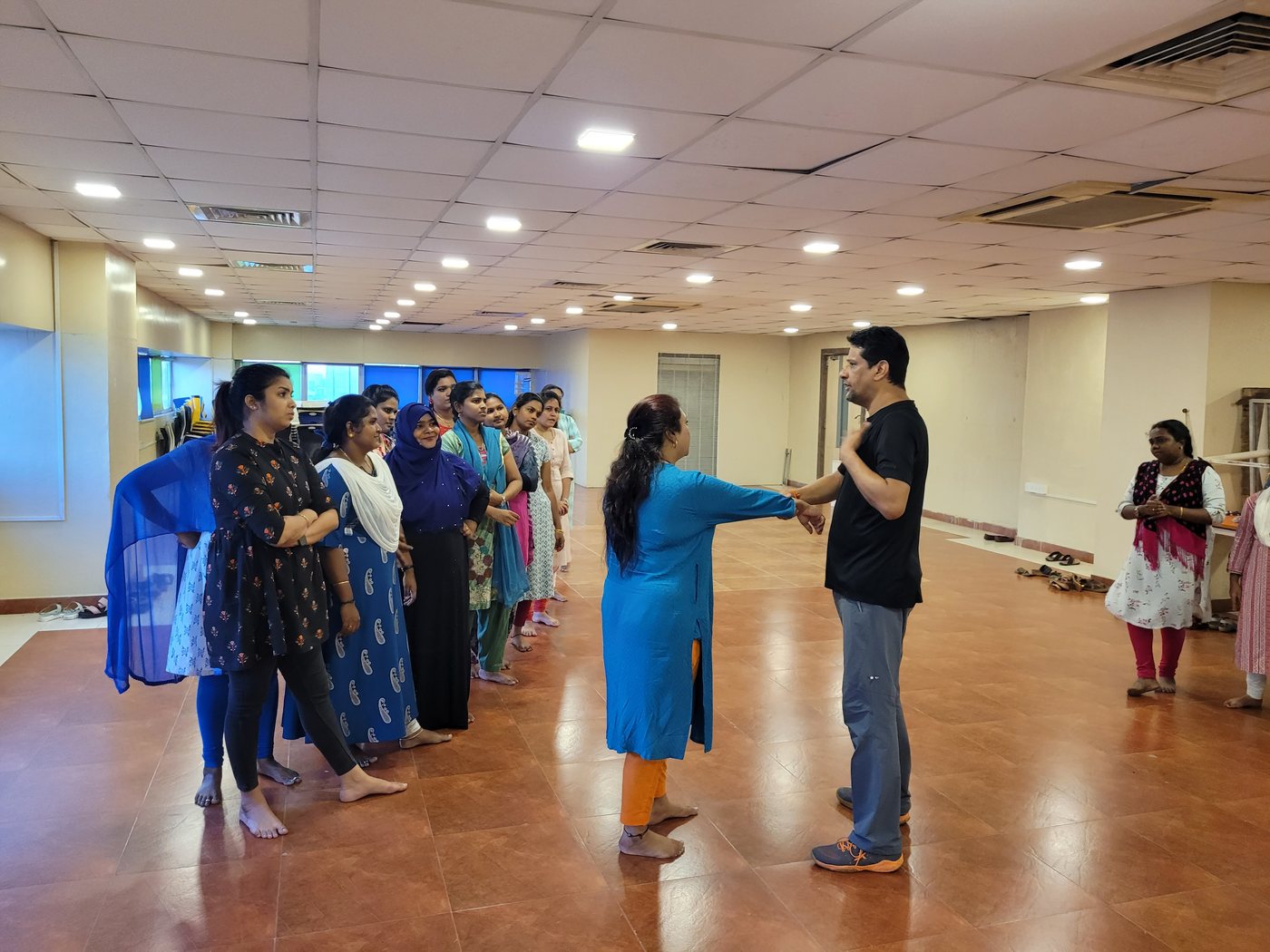
- Simple escapes from a grab of the wrist, the clothes or the hair, with technique rather than strength.
- When there is no way out, simple ways to disarm and get to safety.
- A breath cue that keeps the body steady during a tense moment and afterwards.
The aim is always the same: avoid, de-escalate and get to safety. Physical self-protection is the last layer, not the first response.
Built around shifts
A hospital cannot empty a ward for a day, so the training fits your rosters.
- 2-hour sessions that fit into a training hour or a shift change.
- 4 hours, or the full 8 hours as four 2-hour sessions, for teams that want to go deeper. The 8 hours ends with a programme completion certificate.
- The Year-Round Plan: one session each quarter, so new joiners are covered as they arrive.
- Women-only groups, or mixed groups of nurses, doctors, security and front-desk staff.
Groups of up to 30, at your hospital, in a room with clear floor space.
Tell us about your team, and we will come back to you.
Write to usRequest a corporate proposalor call +91 94454 28378or fill in the enquiry formSafe and supervised
Your staff do not need to be fit for this. Training is real, and it is step by step: everyone starts in the shallow end and moves to the deep end when ready. Every drill is supervised, nobody is pushed beyond what they can do, and anyone can stop at any moment. Tell us about any injuries or health conditions beforehand, and we adapt the drills.
Who leads it
Training is led by Gopal Raghavan, founder of Raw Krav Maga, a Krav Maga Global Graduate Level 2 (G2) and a Certified Unarmed Self-Defence Instructor at NSQF Level 5, under Skill India, teaching since 2014. We have run self-defence workshops for hospital staff in Chennai, and 60+ workshops for 30+ organisations in all.
We are based in Chennai and work across Tamil Nadu. For corporate teams, we also travel to Bangalore and Hyderabad.
Hospital staff training: your questions answered
Do you teach staff to fight?
No. Staff learn to avoid trouble and de-escalate first. The physical skills are simple, taught as a last resort, and aimed at getting free and getting to safety.
Who should attend?
Nurses, doctors, front-desk and billing staff, security teams and anyone who meets patients and relatives. Women-only and mixed groups both work.
Can you train staff on different shifts?
Yes. We can run the same session on different days, so more of your teams are covered. We plan the dates with you around your rosters.
Do staff need to change for the session?
No. Staff train in their uniforms or work clothes, the clothes they will be wearing if a moment like this ever comes.
Is it suitable for staff with no physical training?
Yes. No fitness level or experience is needed. Everything is taught step by step and adapted to each participant.
Does this replace our hospital security?
No. It gives staff skills for the first seconds of a tense moment, and it works alongside your security team and your hospital's own procedures.
What does it cost?
It depends on the format and the group size. We share the fee in a proposal, after a short conversation about your teams.